




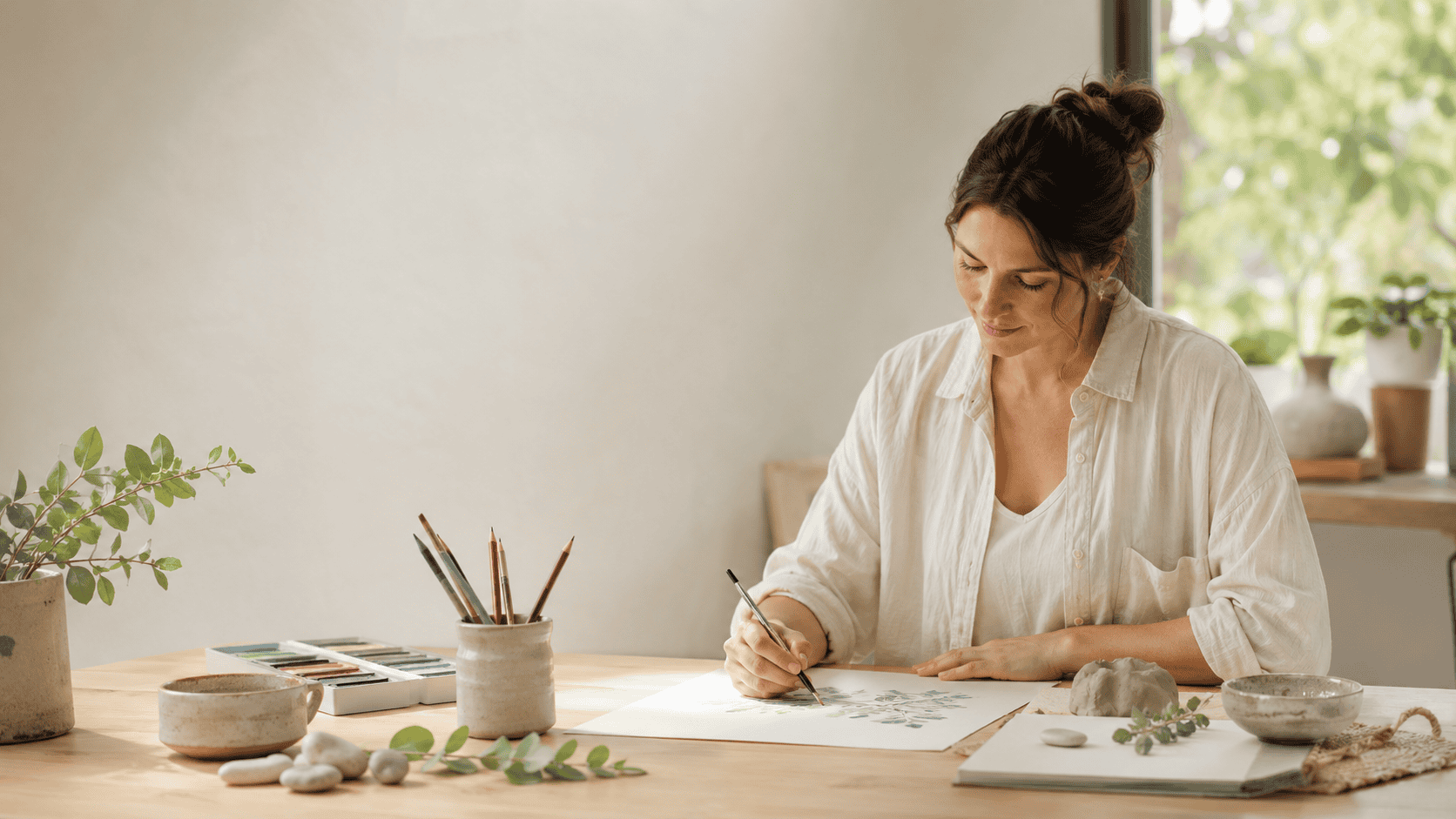
I have been practising as an ACC-registered arts therapist since 2020, following my graduation from Whitecliffe’s Master of Creative Arts Therapy programme. I currently teach postgraduate creative arts therapy students in Ōtautahi Christchurch and work in private practice with adults across a wide age range, although most of my clients are in their 20s and 30s. Alongside my private practice, I co-facilitate a nature-based arts therapy group with Lyndy Broughton.
My work sits at the intersection of creativity, trauma-informed practice, emotional regulation, and embodied therapeutic support. Creative arts therapy can offer a different path to healing, particularly when words alone are not enough or when a person needs a safer, more gradual way to explore complex internal experiences.
Creative arts therapy is a therapeutic approach that uses creative processes such as visual art, movement, writing, sculpture, mindfulness, mixed media, and symbolic expression to support emotional well-being, self-awareness, and healing. It is not about being “good at art”. The focus is on the process, the relationship, and what the creative work helps a person notice, express or understand about themselves.
In my practice, art-making often becomes a bridge between what is felt internally and what can be safely explored externally. A drawing, object, movement or image can hold meaning without requiring a client to explain everything immediately. This can be especially helpful in trauma work, where direct verbal processing may feel too exposing, overwhelming or inaccessible.
In the nature-based arts therapy group I co-facilitate, we work with focused themes that invite participants to connect with aspects of nature as metaphors for the self. For example, we might explore the elements — fire, air, water, and earth — or relate to nature as a nurturing, holding presence.
These themes provide accessible entry points for reflection and expression. They allow participants to explore internal experiences in symbolic, sensory and embodied ways. A person might connect with the image of a leaf moving in the wind, a dense rock held in the earth, or the sun emerging from behind clouds. Each image can say something meaningful without requiring too much vulnerability too soon.
We draw on a range of modalities, including movement, mindfulness, visual art, sculpture, writing, mixed media, and collaborative art-making. The intention is to create an enjoyable, sensory-rich experience that meets people in different ways, depending on their preferences, needs and capacities.
Many of the clients I work with come from creative backgrounds and already have a connection to art-making as a way of understanding themselves. For some, therapy becomes a space to reconnect with creativity that has been lost or disrupted over time. For those without a creative background, the process can take longer, as they gradually build confidence and let their creativity emerge in their own way.
A significant number of my clients are also neurodivergent and are navigating trauma alongside other diagnoses. This can make emotional regulation, sensory sensitivities and day-to-day functioning more complex. Often, they are holding multiple layers of experience, and traditional talk-based approaches may not always feel accessible or sufficient on their own.
I find that arts therapy offers a safe and often uplifting space for clients to encounter different parts of themselves and reconnect with a sense of wholeness. Creative processes can support regulation, build a sense of safety, and, when appropriate, allow for deeper exploration of trauma in a contained way.
A key part of this work is that art-making allows internal states to be externalised. When something is placed onto paper, shaped in clay, represented through movement, or held in an object, it can create a little distance between the person and the experience. This distance can make it easier to see, reflect on and relate to difficult feelings without becoming overwhelmed.
Art-making also shifts the dynamic in the therapy room. There is something shared between therapist and client. The artwork becomes a third presence that can be looked at, wondered about and engaged with together. This can foster a more equal, collaborative and curious therapeutic relationship.
Creativity invites multiple perspectives. Rather than needing to “fix” something immediately, clients can explore, play and remain curious about their experiences. This often fosters acceptance, which can create the conditions for change to emerge more naturally.
I often begin with grounded and accessible approaches, such as simple drawing techniques, collage, positive psychology tools, or self-care planning. I may also use Te Whare Tapa Whā as a framework for wellbeing, supporting clients in considering the physical, emotional, spiritual, whānau, and relational aspects of their lives.
These approaches help establish safety and gradually build familiarity with the creative process. As therapy progresses, I support clients in connecting with their own imaginal language — the personal symbols, images, colours, textures, and sensory experiences that hold meaning for them. This can deepen their connection to their bodies and internal worlds in ways that feel authentic and embodied.
At times, clients need space to talk or vent, particularly when making sense of their experiences. I aim to honour this while gently holding creative intentions in the background, so there is always a pathway back into art-making when appropriate.
My practice is informed by a range of approaches, including mindfulness, Internal Family Systems, attachment theory, and Jungian-informed perspectives, all integrated through creative processes.
In our nature-based group, we begin with a sand tray placed at the centre of the table. Each participant selects a natural object and shares something from nature that reflects how they feel. This might be a leaf blowing in the breeze, a dense rock embedded in the ground, or the sun emerging from behind clouds.
This allows each person to be seen without needing to expose too much vulnerability at the outset. We then introduce a theme for the session and spend around half an hour engaged in art-making, followed by a period of sharing and witnessing.
The artwork can hold complex and layered feelings. Participants can choose how deeply they wish to share verbally, and they remain in control of what they disclose, what they keep private and how they make meaning from the process.
Many clients appreciate having a space where they can engage in “creative conversations” about their experiences. This often brings fresh perspectives and can help loosen feelings of shame or stuckness.
Creativity seems to open up possibilities. Trauma can lead to rigidity, where staying with the familiar may feel safer than risking change. Through art-making, clients can begin to imagine alternatives—different ways of being, relating, or responding.
Over time, I often see clients develop a stronger sense of self-trust and self-worth. There is also a growing connection to intuition and decision-making. The act of choosing materials, following impulses, and reflecting on their creations supports a sense of agency that can be deeply reparative, often extending into everyday life.
Art-making can also foster deeper self-acceptance, alongside a sense of connection with nature and reflection through the natural world.
I see arts therapy as a powerful support for trauma recovery because it allows clients to engage with themselves in ways that foster agency and choice. They can decide how they want to work, what materials to use, how deeply to explore and at what pace.
It also brings in elements of play, curiosity and connection, which can help soften fear and anxiety around the therapeutic process. In this way, creativity becomes more than a tool. It becomes a relational and living process that can grow with the client and support healing over time.
Whitecliffe offers a creative arts therapy study that supports students to engage with both theory and embodied learning. The programme helps students deepen their understanding of the creative process, develop the self-awareness required for therapeutic holding and expand their range of creative practices.
For people who feel called to support others through creativity, therapeutic relationships, and embodied practice, creative arts therapy offers a meaningful professional pathway. It brings together art-making, reflection, psychological understanding and clinical learning in a way that prepares students to work with people, communities and complex human experiences.
Do you need to be good at art to benefit from Creative Arts Therapy?
No. Creative arts therapy is not about artistic skill or producing a finished artwork. The focus is on expression, reflection, process and meaning-making.
How can creative arts therapy help with trauma?
Creative arts therapy can help by giving people a safe way to externalise feelings, explore experiences symbolically, support emotional regulation and reconnect with a sense of agency and choice.
What kinds of creative processes are used in arts therapy?
Creative arts therapy may include drawing, painting, collage, clay, sculpture, movement, writing, mindfulness, mixed media, nature-based reflection, and collaborative art-making.
Is creative arts therapy only for creative people?
No. People with and without creative backgrounds can benefit. Some people reconnect with the creativity they have lost, while others discover creative expression gradually through the therapeutic process.
Where can I study Creative Arts Therapy in New Zealand?
Whitecliffe offers postgraduate study in Creative Arts Therapy, combining theory, embodied learning, creative practice and clinical development.
